Guide
Plastic waste in Indonesia: collection, rules and plastic credits

On this page 8 sections
Indonesia is one of the three countries where Reclaimed Earth works with plastic recovery projects, alongside India and the Philippines. It is a country of thousands of islands, fast-growing cities and rivers that carry waste to the sea. That makes collection on land, before plastic reaches a river, especially important.
If you are new to plastic credits, start with What is a plastic credit?.
How much plastic waste Indonesia produces
Estimates differ by source and year.
- The National Plastic Action Partnership (NPAP), a government-led platform with the World Economic Forum, estimated in 2020 that Indonesia generates 6.8 million tonnes of plastic waste a year, growing by about 5% a year. It considered 70% of it, about 4.8 million tonnes, mismanaged.
- The World Bank estimated in 2021 that Indonesia generates about 7.8 million tonnes of plastic waste a year, of which 4.9 million tonnes is not properly managed.
The World Bank also found that rivers carry 83% of the plastic that leaks from land into Indonesia's seas. About 40% of urban residents had no access to basic waste collection, and an estimated 85% of plastic waste in rural areas was not formally collected.
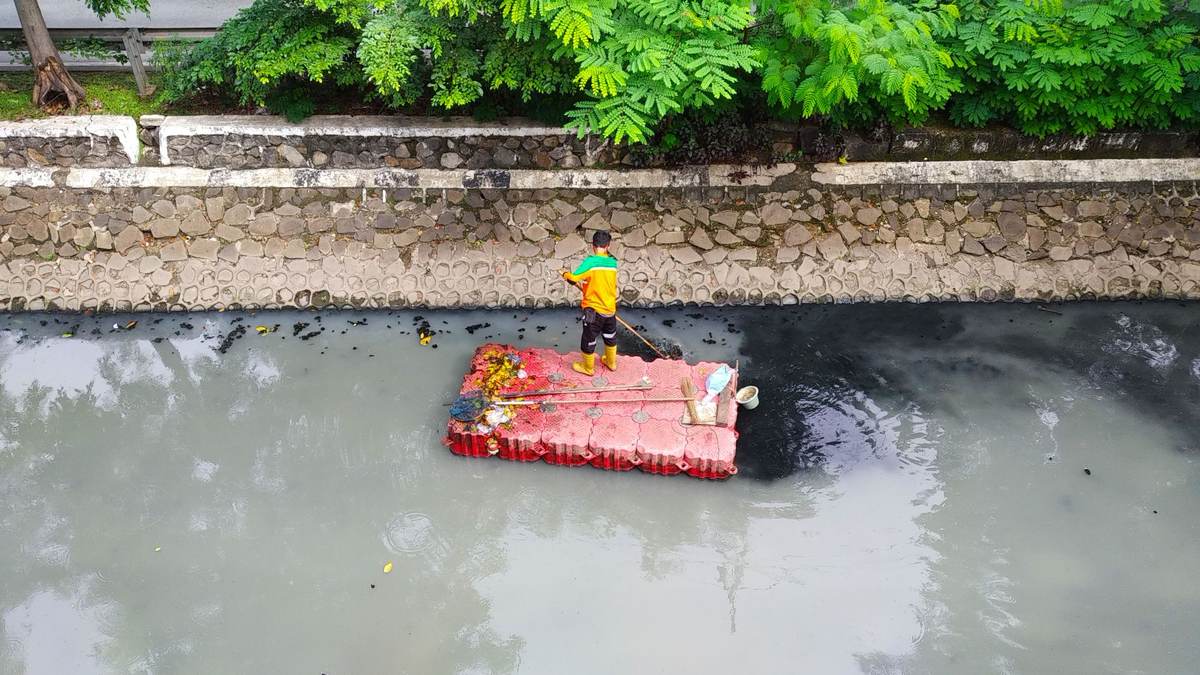
Those gaps are where plastic leaks, and where collection projects try to work.
National targets and rules
Marine debris action plan. Presidential Regulation 83/2018 set a national action plan on marine debris for 2018 to 2025, with a target to cut marine plastic debris by 70% by 2025. A study published by the SMERU Research Institute reports a 41.68% reduction in marine plastic waste from 2018 to 2024, short of the target. Its authors point to weak coordination between levels of government, weak enforcement and continuing growth in plastic use.
Producer roadmaps. Ministerial Regulation P.75/2019 asks producers, retailers and food service businesses to follow a waste reduction roadmap from 2020 to 2029, with a target of cutting the waste from their products and packaging by 30%. It works through plans that companies submit to the environment ministry. Our EPR guide compares it with rules in the UK, the EU and other Asian countries.
Local bans. Some regions have gone further. Bali's Governor Regulation 97/2018 restricts single-use plastic bags, styrofoam and plastic straws.
The NPAP plan. The 2020 multistakeholder action plan aims to reduce plastic leakage into Indonesia's coastal waters by 70% by 2025 and to reach near-zero plastic pollution by 2040, through less plastic use, redesign, more collection and more recycling.
- 2018Presidential Regulation 83/2018: marine debris action plan, 70% cut by 2025
- 2018Bali Governor Regulation 97/2018 restricts single-use plastic bags, styrofoam and straws
- 2019Regulation P.75/2019: producer roadmaps for 2020–2029, 30% waste reduction
- 2020NPAP action plan: 70% less leakage by 2025, near-zero plastic pollution by 2040
How collection works on the ground
Public waste services cover only part of the country. Where they stop, collection depends on a mix of community waste banks, informal waste pickers, small aggregators and recyclers, and private and community collection programmes.
Low-value plastic is the hardest part. Bottles and rigid containers have buyers. Sachets, films and multilayer packaging often do not, so nobody collects them unless someone pays for it. Those are the materials most likely to end up in rivers.
Where plastic credits fit
Indonesia's producer roadmap is a planning duty, not a fee-based EPR system like the UK's. That leaves room for voluntary funding to pay for collection in places public services do not reach. Plastic credits are one way to do that.
The same questions apply as anywhere else, and a few matter especially in Indonesia:
Is the collection additional? Many places already have informal collection of valuable plastic. A credit should fund something that would not happen otherwise, such as low-value plastic or new areas.
Where does the plastic go? Recycling capacity for some materials is limited, so check whether the plastic was recycled, co-processed or landfilled. Our guide to what happens to collected plastic explains the options.
Who does the work? Find out how waste pickers and waste bank members are paid and protected. See waste pickers and plastic credits.
Is it ocean-bound? If a project uses that term, ask which category and where. Ocean-bound plastic explains the definitions.
Is any of it counted elsewhere? Check that a producer is not also counting the same tonnes towards its own roadmap.
What I look for
In Indonesia, stopping plastic before it reaches the sea means working along rivers and with the communities beside them. I want to follow the plastic past the point of collection and see where it ends up.
Honest Ocean, our partner in Indonesia, links collection and sorting to the production of recycled resin, with traceability of the material. That link is what I look for: it shows the plastic becoming something useful again, not only leaving the riverbank.
How to describe credits from Indonesia
Be specific about place, material and outcome. Name the province or city, the type of plastic, the tonnes, the standard and what happened to the material. Say whether it was recycled or managed in another way. Avoid "saving the ocean" or "removed from the sea" unless the plastic came from the sea. Our guide to buying plastic credits responsibly covers wording.
The Reclaim Earth newsletter
Follow the plastic, not the promises.
One email a month on plastic recovery.
Updates from our partner projects, plain-English explainers on plastic credits, and the questions worth asking of any plastic claim. Free, and you can unsubscribe at any time.
Sign-ups are handled by Substack. See Substack's privacy policy, our privacy notice and our cookie notice.
Frequently asked questions
How much plastic waste does Indonesia produce?
Between 6.8 million tonnes (NPAP, 2020) and 7.8 million tonnes (World Bank, 2021) a year, depending on the estimate.
Did Indonesia meet its 70% marine debris target?
A study published by the SMERU Research Institute reports a 41.68% reduction in marine plastic waste from 2018 to 2024, short of the 70% target for 2025.
Does Indonesia have EPR for packaging?
Indonesia uses a producer waste reduction roadmap under Regulation P.75/2019, with a 30% reduction target. It is based on plans rather than fees.
Why do rivers matter so much in Indonesia?
The World Bank estimated that rivers carry 83% of the plastic leaking from land into Indonesia's seas.
Can plastic credits help in Indonesia?
They can fund collection where public services do not reach, especially of low-value plastic. Check additionality, the end destination and how collectors are treated.
Sources
- NPAP, Radically reducing plastic pollution in Indonesia: a multistakeholder action plan (April 2020)
- Global Plastic Action Partnership, Indonesia
- World Bank, New data-driven approach maps plastic pollution from source to sea in Indonesia (May 2021)
- UNEP LEAP, Presidential Regulation No. 83/2018 on marine debris management
- SMERU Research Institute, Advancing regional cooperation to combat marine debris and enhance livelihoods in Indonesia
- Indonesia Ministry of Environment and Forestry, Regulation P.75/2019 on the producers' waste reduction roadmap (copy via Duke Nicholas Institute)
- Tempo, Bali Governor bans use of plastic, styrofoam (December 2018)
Published by Reclaimed Earth Limited (Companies House 17392812), which works with plastic recovery projects in India, Indonesia and the Philippines and has a commercial interest in plastic credits. Honest Ocean is a Reclaimed Earth partner. Edited with the Reclaimed Earth editorial team. Last updated 20 October 2026.